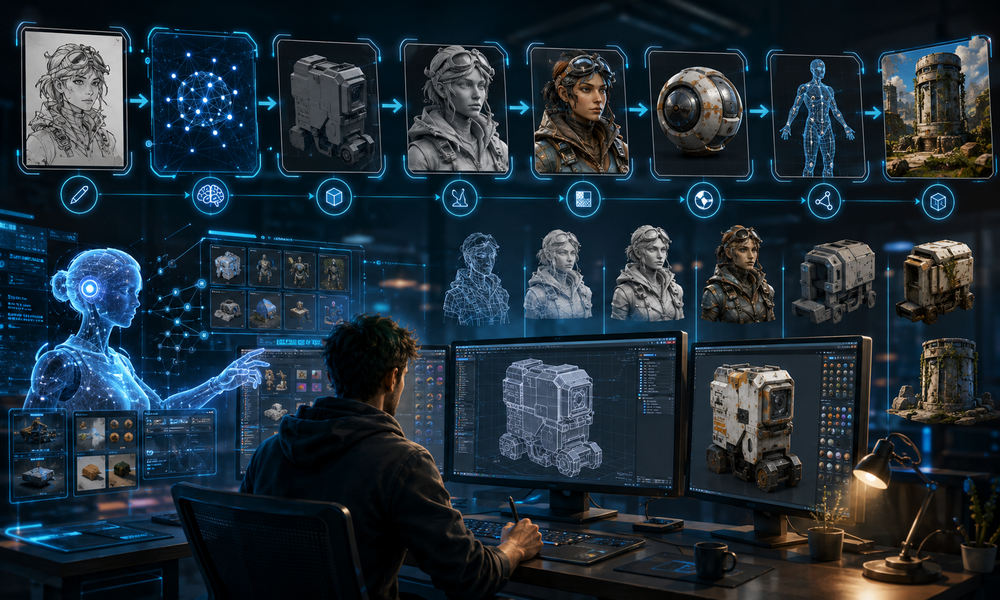
Creating high-quality 3D assets has always required a combination of creativity and technical skills.
A designer may start with an idea, reference image, or concept sketch. Then comes modeling, texturing, UV mapping, optimization, and finally preparing the asset for its target environment.
For professional artists, this workflow is familiar. However, many creators today are working with increasing numbers of 3D assets for games, visualization, e-commerce, AR, VR, and digital experiences.
The challenge is no longer only creating a 3D model.
The challenge is creating a model that is visually appealing, optimized, and ready to use.
This is where artificial intelligence is beginning to influence the 3D workflow.
From Manual Creation to AI-Assisted 3D Production
Traditional 3D production often requires many hours of repetitive work.
Artists may spend significant time:
- Creating base models
- Adjusting materials
- Preparing UV layouts
- Optimizing topology
- Exporting different formats
- Testing assets in different environments
These steps are essential, but some parts of the process can be time-consuming.
AI-powered tools are changing this by helping artists speed up repetitive tasks while keeping creative control in human hands.
The goal is not to replace 3D artists.
The goal is to help creators spend more time on design decisions and less time on technical preparation.
Better Textures With AI Assistance
Textures are one of the most important elements of a 3D asset.
A model with simple geometry can still look realistic with high-quality materials and surface details. On the other hand, even a detailed model can feel unfinished without proper texturing.
Creating textures manually can require experience with materials, lighting, and image editing.
This is where an AI Texture Generator can help creators explore different surface styles faster.
AI texture tools can assist with generating or improving visual details such as:
- Material appearance
- Surface patterns
- Color variations
- Realistic details
- Stylized effects
For game artists, this can help create environment assets faster.
For product visualization, it can help produce more realistic previews.
For independent creators, it provides an easier way to experiment with different artistic directions.
AI does not remove the creative role of artists. Instead, it gives creators a faster starting point for developing unique visual styles.
Why UV Mapping Still Matters
A common misunderstanding among beginners is that creating a model is the final step.
In reality, a 3D model needs a proper connection between its geometry and textures.
This is where UV mapping becomes important.
UV unwrapping converts the surface of a 3D model into a 2D layout so textures can be correctly applied.
However, UV preparation can become complicated with:
- Complex characters
- Scanned objects
- AI-generated models
- High-detail assets
- Organic shapes
Poor UV layouts can cause stretched textures, incorrect material placement, and inefficient texture usage.
An AI UV Unwrapping Tool can help automate this part of the workflow by generating cleaner UV layouts for 3D models.
For artists working with many assets, reducing manual UV work can significantly improve productivity.
This is especially valuable in environments where teams need to prepare many models quickly, such as games, virtual environments, and digital product catalogs.
Making 3D Models More Practical With Retopology
Another important step in the 3D workflow is optimization.
A model may look excellent but still be difficult to use because of:
- Excessive polygon count
- Uneven mesh density
- Poor topology
- Large file size
This is common with scanned models, sculpted assets, and AI-generated 3D objects.
Retopology helps solve this problem by rebuilding the mesh structure into a cleaner and more efficient form.
An AI 3D Retopology Tool can assist creators in preparing models for different applications.
Optimized topology can improve:
- Real-time performance
- Game engine compatibility
- Web 3D loading speed
- Editing flexibility
- Animation workflows
For example, a highly detailed sculpt may be excellent for design exploration but unsuitable for a mobile game or web viewer. Retopology creates a better balance between visual quality and performance.
The Future of 3D Creation Is About Complete Workflows
The future of AI in 3D is not only about generating models.
A complete workflow involves multiple stages:
- Creating or generating a model
- Improving textures and materials
- Preparing UV layouts
- Optimizing geometry
- Exporting for different platforms
Each step affects the final quality of the asset.
This is why AI tools that support the entire workflow are becoming increasingly valuable.
A creator may start with an idea, generate a model, improve its appearance, optimize the mesh, and prepare it for use without spending unnecessary hours on repetitive technical tasks.
How Businesses Can Benefit From AI 3D Workflows
AI-assisted 3D workflows are not only useful for artists.
Many industries are exploring 3D content:
Gaming
Developers can create and optimize assets faster during prototyping and production.
E-commerce
Brands can create interactive product experiences and digital previews.
Architecture and Visualization
Designers can build realistic environments and presentations more efficiently.
3D Printing
Creators can prepare personalized objects, collectibles, and prototypes.
Digital Experiences
Companies can create AR and VR content with fewer technical barriers.
As 3D content becomes more common, efficient workflows will become increasingly important.
Human Creativity Remains the Most Important Element
Although AI can accelerate many technical processes, creativity remains the foundation of great 3D work.
The best results still come from artists who understand:
- Design principles
- Composition
- Materials
- Storytelling
- User experience
AI works best as a creative assistant.
It removes repetitive tasks, speeds up experimentation, and allows creators to explore more possibilities.
Final Thoughts
The modern 3D workflow is becoming more accessible because AI is helping solve some of the most time-consuming parts of production.
From generating better textures to improving UV layouts and optimizing geometry, AI tools are helping creators move from ideas to finished assets faster.
For artists, designers, developers, and businesses working with 3D content, the future will likely not be about choosing between traditional workflows and AI.